The desk-based risk assessment tool asks eight yes or no questions to calculate a preliminary overall risk of climate change impacts upon a particular HSM.
Scope
This is the first of two tools to progress the development of a climate change risk assessment for Antarctic heritage and to deliver the action on Antarctic heritage sites specified in the Climate Change Response Work Programme (CCRWP) presented at CEP XXIV by New Zealand, Argentina, Norway, and the United Kingdom.
This initial coarse-assessment tool is intended to help managers of Antarctic Historic Sites and Monuments (HSM) assess the immediate risks of climate change impacts, inform decision-making, and prioritise future planning and research. Managers will find this tool useful for identifying priorities across multiple sites/locations and distinguishing which sites are likely to be most at risk. Similarly, the tool can be used for identifying low-risk sites. With the results of this initial coarse analysis in hand, managers can strategically determine which sites will benefit from further investigation in the form of fieldwork, a typically resource-expensive undertaking in Antarctica.
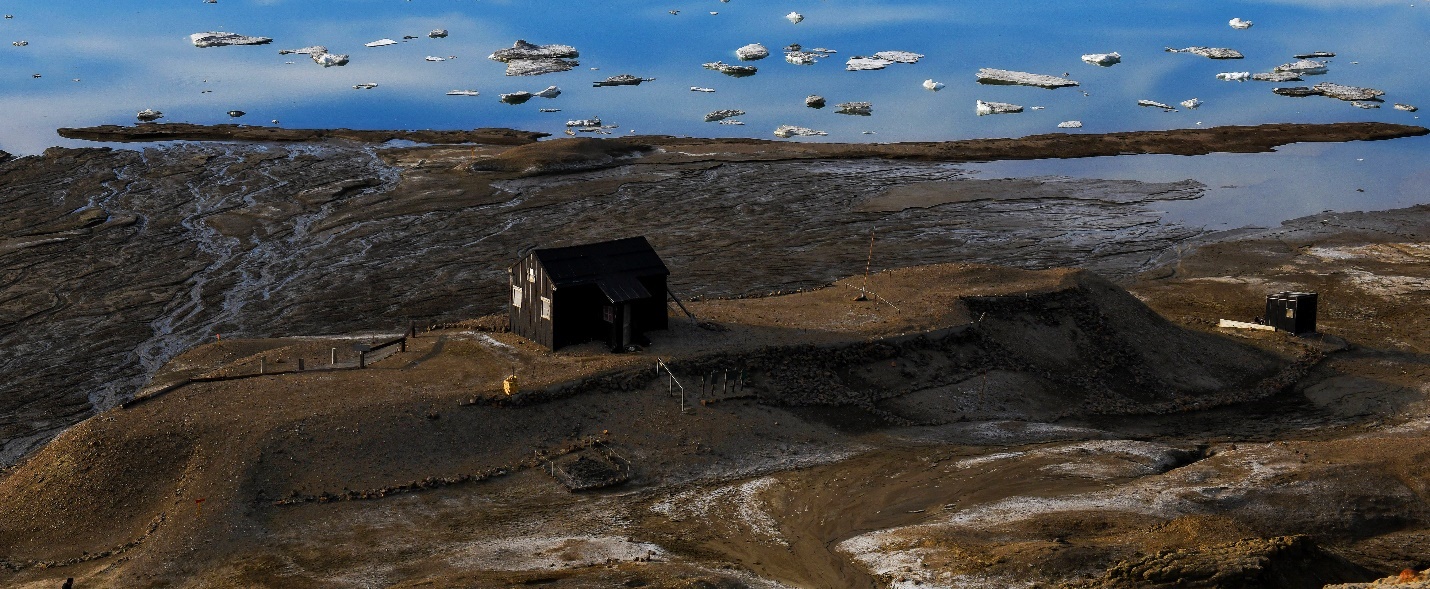
Figure 1 - HSM No. 38, the wooden hut on Snow Hill Island built in February 1902 by the main party of the Swedish South Polar Expedition led by Otto Nordenskjöld. Photo by D. Avango, 2020.
Background
The Scientific Committee on Antarctic Research (SCAR) Decadal Synopsis presented at the 44 th Antarctic Treaty Consultative Meeting (ATCM) at Berlin, leads with the following statement: “Scientific evidence is abundantly clear and convincing that due to the current trajectory of human- derived emissions of CO₂ and other greenhouse gases, the atmosphere and ocean will continue to warm, the ocean will continue to acidify, atmospheric and ocean circulation patterns will be altered, the cryosphere will continue to lose ice in all forms, and sea level will rise” (Chown et al., ; ATCM 44, 2022).
Global warming (i.e., increased atmospheric temperatures) results in changes to the patterns of behaviours of natural and anthropogenic drivers which can negatively impact heritage sites in Antarctica. These include:
- Decreased sea ice mass and extent.
- Increased frequency of ice-free conditions (i.e., open water).
- Increased frequency and duration of warm weather episodes and thaw events.
- Increased storm frequency and intensity.
- Increased precipitation in coastal areas.
- Rise in sea level (resulting from glacial retreat, ice melt and thermal expansion of sea water in response to higher temperatures).
- Increased marine acidification.
- Receding and more active permafrost.
- Increased visitor accessibility.
Antarctica is projected to increasingly experience concurrent and multiple changes in climate impact-drivers (IPCC AR6, 2022). Certain combinations of these drivers can result in positive feedbacks which greatly increase the risks of associated climate change impacts.
Since 2005 the World Heritage Committee (WHC) has led a coordinated effort on behalf of UNESCO to quantify the impacts to heritage associated with climate change. This collaborative work has included expert advice from the International Centre for the Study of the Preservation and Restoration of Cultural Property (ICCROM), International Council on Monuments and Sites (ICOMOS), and others (“UNESCO,” 2023). WHC concludes there are several direct impacts to heritage:
- Loss of archaeological evidence preserved in previously stable (i.e., frozen) ground.
- Damage to historic buildings and objects from wind, subsidence, water ingress, prolonged periods of wetting, high humidity, freeze-thaw activity, salt migration, and increased UV-levels.
- Loss of timber and other organic materials due to increased biological activity and the potential introduction of new pests.
- Damage to historic sites from flooding and inundation from the sea.
- Erosion of sites from flowing water.
Climate change impacts to Antarctic heritage are predictable. The likelihood and severity of key risks to Antarctic Historic Sites and Monuments (HSM) can be determined using basic risk assessment tools, and by so doing managers of HSMs can act proactively to mitigate those risks. This initial (i.e., desk-based) risk assessment tool is intended to help managers HSMs which are more likely to be at greater (or lower) risk, and to inform their management on a prioritized basis.